


I'm pissed that my local Walmart is closing. As much as I'd rather support local businesses, they mostly closed down because they couldn't compete with Walmart. So now we'll have no Walmart and no small businesses, just a sad almost empty mall that will probably close down within the year. Hopefully the local businesses can bounce back.


The Bitching thread
- Thread starter AirBo
- Start date
You are using an out of date browser. It may not display this or other websites correctly.
You should upgrade or use an alternative browser.
You should upgrade or use an alternative browser.
Can’t feel sorry for a US store closing lol.I'm pissed that my local Walmart is closing. As much as I'd rather support local businesses, they mostly closed down because they couldn't compete with Walmart. So now we'll have no Walmart and no small businesses, just a sad almost empty mall that will probably close down within the year. Hopefully the local businesses can bounce back.
It may suck for convenience but they don’t deserve our business.
I feel guilty every time I shop at Costco even though I try to avoid buying any product made in the US.
I'm pissed that my local Walmart is closing. As much as I'd rather support local businesses, they mostly closed down because they couldn't compete with Walmart. So now we'll have no Walmart and no small businesses, just a sad almost empty mall that will probably close down within the year. Hopefully the local businesses can bounce back.
Canadian small businesses are closing faster than they’re opening: report
A new report shows small businesses in Canada are closing faster than they’re opening.
 www.ctvnews.ca
^^^^ As per the latest report more businesses are closing down in Canada then opening up. Canada is just not the best place to start a business. Too high taxes, too much red tape, increasing costs are not good combinations for a small business.


CDN or Dorval?I'm pissed that my local Walmart is closing. As much as I'd rather support local businesses, they mostly closed down because they couldn't compete with Walmart. So now we'll have no Walmart and no small businesses, just a sad almost empty mall that will probably close down within the year. Hopefully the local businesses can bounce back.
CDN. There's a third one closing as well, Point-Aux-Trembles.CDN or Dorval?
True. I dislike Walmart but they've been there awhile and driven away most of the local competition. Would be great if the local businesses fill the void, but I have my doubts about that happening. It will probably drive business down for many of them. Majority of the people going to the mall are there for Walmart and the Asian grocery store. Now that Walmart is gone, there's going to be far fewer people around.Can’t feel sorry for a US store closing lol.
It may suck for convenience but they don’t deserve our business.
I feel guilty every time I shop at Costco even though I try to avoid buying any product made in the US.
The company that will benefit the most from this is probably Amazon. I can't go to Walmart to get a new pasta strainer, HDMI cord and slippers but I can easily order that all through Amazon.
All my old vinyl is made in USA with along with My Fender Strat! Trump was not around then!Can’t feel sorry for a US store closing lol.
It may suck for convenience but they don’t deserve our business.
I feel guilty every time I shop at Costco even though I try to avoid buying any product made in the US.

The one in the plaza? Google isn't helping, and since this is the bitching thread I'd like to bitch that Google is getting less and less helpful but the alternatives are worse.CDN. There's a third one closing as well, Point-Aux-Trembles.
True. I dislike Walmart but they've been there awhile and driven away most of the local competition. Would be great if the local businesses fill the void, but I have my doubts about that happening. It will probably drive business down for many of them. Majority of the people going to the mall are there for Walmart and the Asian grocery store. Now that Walmart is gone, there's going to be far fewer people around.
The company that will benefit the most from this is probably Amazon. I can't go to Walmart to get a new pasta strainer, HDMI cord and slippers but I can easily order that all through Amazon.
Wondering what will replace it and how they want to turn the mall after the renovationCDN. There's a third one closing as well, Point-Aux-Trembles.
True. I dislike Walmart but they've been there awhile and driven away most of the local competition. Would be great if the local businesses fill the void, but I have my doubts about that happening. It will probably drive business down for many of them. Majority of the people going to the mall are there for Walmart and the Asian grocery store. Now that Walmart is gone, there's going to be far fewer people around.
The company that will benefit the most from this is probably Amazon. I can't go to Walmart to get a new pasta strainer, HDMI cord and slippers but I can easily order that all through Amazon.
Yes the one in Plaza CDN.The one in the plaza? Google isn't helping, and since this is the bitching thread I'd like to bitch that Google is getting less and less helpful but the alternatives are worse.
I just pray that the little Chinese restaurant will stay (the uncle/auntie there seem to say they will) after the renovation

The one in Dorval has been doomed for a long time and everybody knew it. The whole mall it's attached is dying off too as the tenants have been largely driven out to make way for development there. Not just that mall either. the small strip malls, the old theatre and other buildings along that strip are either gone or slated to go. It's going to be an eyesore for sure.

Why do we not have any Asian outcall agencies?
All these agencies popping up, but all are incall. They may include outcall in their ads, but when you ask, you get an answer of " oh, sorry, no out call today. And if they say okay, they add 100$ to the hourly rate. Just so you forget about it and never ask again.
What a fuvking world we live in.
All these agencies popping up, but all are incall. They may include outcall in their ads, but when you ask, you get an answer of " oh, sorry, no out call today. And if they say okay, they add 100$ to the hourly rate. Just so you forget about it and never ask again.
What a fuvking world we live in.
Instead of only bitching about how dirty Montreal is (because it's true) I myself picked up some trash from my local park. Going to do it again tonight. Every little bit counts as they say! Maybe one day we'll have people who know how to dispose of their trash properly!

I used to be part of the yearly Mont-Royal cleaning social event. It was very satisfying, had to stop because of sciatica problems, otherwise I would still participate.Instead of only bitching about how dirty Montreal is (because it's true) I myself picked up some trash from my local park. Going to do it again tonight. Every little bit counts as they say! Maybe one day we'll have people who know how to dispose of their trash properly!
STREETS / Montréal, Toronto and Burlington
Comparison of the structure of a typical local street
Based on official standards and comparative studies:
- MTQ for Quebec
- MTO for Ontario
- VTrans for Vermont
1. Montréal (Quebec) / typical local street
- Bituminous concrete (total asphalt): about 7.5 cm.
- Granular foundation (often MG-20): 15 to 20 cm.
- Subfoundation (often MG-112 or equivalent): 30 cm.
2. Toronto (Ontario) / typical local street
- Bituminous concrete (total asphalt): 9 cm. This is slightly more generous than in Montréal.
- Granular foundation (Granular A): 15 to 20 cm.
- Subfoundation (Granular B): 30 cm.
Ontario and Quebec are very similar here. Costs are optimized, with a relatively thin foundation and a good sub-base for drainage.
3. Vermont (Burlington and surroundings)
- Bituminous concrete (total asphalt): 10 cm.
- Granular foundation (base course): 50 cm.
This is the big difference. Vermont builds a deep granular base from the start to better withstand freeze-thaw cycles.
- Subfoundation (sand cushion anti-frost): about 30 cm. Comparable to the other two regions.
Why are Vermont's roads more durable?
The thick foundation (50 cm) better absorbs movements caused by freezing and thawing, even if the asphalt isn't much thicker.
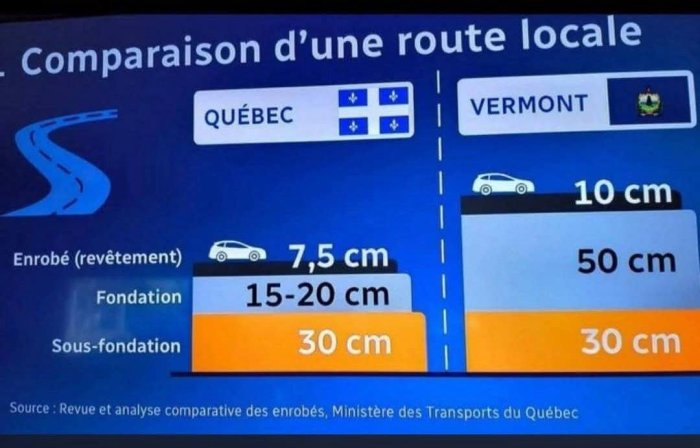
SIZE (of the granular foundation) MATTERS!
Comparison of the structure of a typical local street
Based on official standards and comparative studies:
- MTQ for Quebec
- MTO for Ontario
- VTrans for Vermont
1. Montréal (Quebec) / typical local street
- Bituminous concrete (total asphalt): about 7.5 cm.
- Granular foundation (often MG-20): 15 to 20 cm.
- Subfoundation (often MG-112 or equivalent): 30 cm.
2. Toronto (Ontario) / typical local street
- Bituminous concrete (total asphalt): 9 cm. This is slightly more generous than in Montréal.
- Granular foundation (Granular A): 15 to 20 cm.
- Subfoundation (Granular B): 30 cm.
Ontario and Quebec are very similar here. Costs are optimized, with a relatively thin foundation and a good sub-base for drainage.
3. Vermont (Burlington and surroundings)
- Bituminous concrete (total asphalt): 10 cm.
- Granular foundation (base course): 50 cm.
This is the big difference. Vermont builds a deep granular base from the start to better withstand freeze-thaw cycles.
- Subfoundation (sand cushion anti-frost): about 30 cm. Comparable to the other two regions.
Why are Vermont's roads more durable?
The thick foundation (50 cm) better absorbs movements caused by freezing and thawing, even if the asphalt isn't much thicker.
SIZE (of the granular foundation) MATTERS!

I am extremely tired of the madness and desperation I encounter daily on my way to and from work on the STM. It has become a nightmare. It is so bad that I consciously avoid certain stations.
It`s not just you. It`s getting worse. Just a couple of very recent articles:I am extremely tired of the madness and desperation I encounter daily on my way to and from work on the STM. It has become a nightmare. It is so bad that I consciously avoid certain stations.
https://www.lapresse.ca/actualites/2026-04-09/itinerance-au-quebec/un-nouveau-sommet-est-atteint.php
Bring in too many people; don't build enough homes/apartments: rents go up by a lot: homelessness goes up. Add extremely toxic drugs to the mix circulating on the streets and you have the perfect storm. Canada is basket case.
Very well said, and the crux of the problem. The sad part is that Canadians elected the same government to clean up their own mess, and they now have a manufactured majority to do what they want.It`s not just you. It`s getting worse. Just a couple of very recent articles:
https://www.lapresse.ca/actualites/2026-04-09/itinerance-au-quebec/un-nouveau-sommet-est-atteint.php
Bring in too many people; don't build enough homes/apartments: rents go up by a lot: homelessness goes up. Add extremely toxic drugs to the mix circulating on the streets and you have the perfect storm. Canada is basket case.
It will not get better, only worse. This summer will be nasty.
And the two least-well informed reactions I hear most often are 1) you are racist 2) blame the landlords. This is 100% ignorant. We blame the government for having had a thoroughly mismanaged immigration policy. We were a model for the world with respect to immigration before Trudeau made a big whole mess out of it. The damage that he inflicted on this country is beyond measure. And now he is partying dressed like a teenager with his pop star girlfriend. I just cannot believe it.Very well said, and the crux of the problem. The sad part is that Canadians elected the same government to clean up their own mess, and they now have a manufactured majority to do what they want.
It will not get better, only worse. This summer will be nasty.
Again, well said and true. The point system needs to be brought back, and the family class and Bill C3, which just passed the Senate, must be repealed. Most Canadians are ill-informed and ignorant. That is my bitch and gripe today!And the two least-well informed reactions I hear most often are 1) you are racist 2) blame the landlords. This is 100% ignorant. We blame the government for having had a thoroughly mismanaged immigration policy. We were a model for the world with respect to immigration before Trudeau made a big whole mess out of it. The damage that he inflicted on this country is beyond measure. And now he is partying dressed like a teenager with his pop star girlfriend. I just cannot believe it.
I am off to the office now, and about to board the Metro system. Hopefully, I won't encounter anyone taking a shit on the car or shooting up today.

Similar threads
- Replies
- 2
- Views
- 385
- Replies
- 36
- Views
- 2K

- Replies
- 36
- Views
- 4K
